

A source of truth is the one place where a location’s details are decided, so that every other system copies from it rather than arguing with it. Most organisations have four competing versions: the website, the Business Profile, a spreadsheet somebody maintains, and whatever the branch manager tells customers on the phone. Pick one, name an owner for it, and make every other system a copy. Without that, listings management is just repeated correction.
A source of truth for location data sounds like an abstraction until you test it. Ask three people in a fifty-branch business what time the Watford store opens on a Sunday and you will often get three answers, all of them sincerely believed, two of them published somewhere.
That is not a data entry problem. It is a governance problem wearing a data entry costume, and no amount of bulk editing fixes it.
Why Google makes this urgent
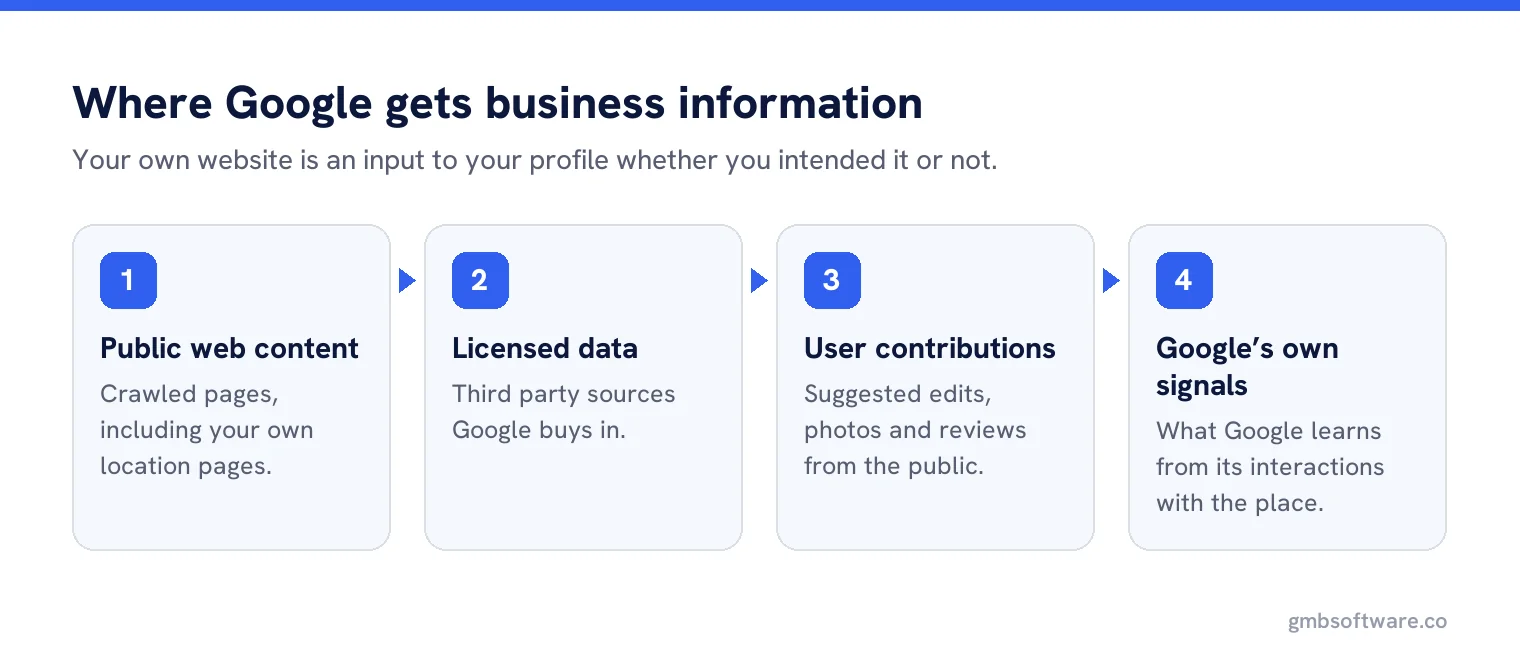
Google does not take your word for a location and leave it there. Its page on how it sources business information lists publicly available content such as crawled web pages, licensed data from third parties, contributions from users, and Google’s own interactions with the place.
That means your website is an input to your Business Profile intended or not. If the site says one thing and the profile says another, you have not got two records, you have got a fight, and Google may resolve it for you. Suggested edits supported by other public information can be published after four days if nobody responds.
Choosing the system that holds the truth
| Candidate | Good when | Problem |
|---|---|---|
| Your website CMS | The site already has a location page per branch, kept current. | Marketing owns it, and marketing is not told when hours change. |
| A listings platform | Listings are the main use of the data, and it pushes to Google and directories. | Needs discipline to stay the master rather than another copy. |
| An internal operations system | Hours, closures and openings are already managed there by the people who know. | Rarely has the fields Google wants, so it needs mapping. |
| A spreadsheet | Under ten locations, one maintainer. | Becomes four spreadsheets within a year. |
There is no universally right answer. The test is which system the people who know the facts already touch. Data governance that requires operations staff to log into a marketing tool fails quietly and quickly.
What belongs in the record
More than the obvious. The fields that cause arguments are the ones nobody writes down: which phone number is published versus which rings internally, whether the entrance is on the side street, which car park customers may use, what the branch is called in the real world as opposed to in the finance system.
- Name as it appears on the sign, exactly.
- Address in the local postal format, with the unit or floor.
- Published phone number, and who answers it.
- Hours, including breaks, seasonal variations and the holiday calendar.
- Store code, which joins this record to Google and everything else.
- Service area, if the business travels.
- Who owns this record locally, by name.
One owner per record
A source of truth with no named owner is a shared document, and shared documents drift. The owner does not have to be senior. In most estates the right owner is the person who would know first if something changed: the branch manager for hours and closures, head office for the name and category.
Split ownership by field rather than by record where you can. It is normal for a branch to own its hours while the brand owns its name, and writing that split down prevents the most common argument in multi-location marketing.
Making every other system a copy
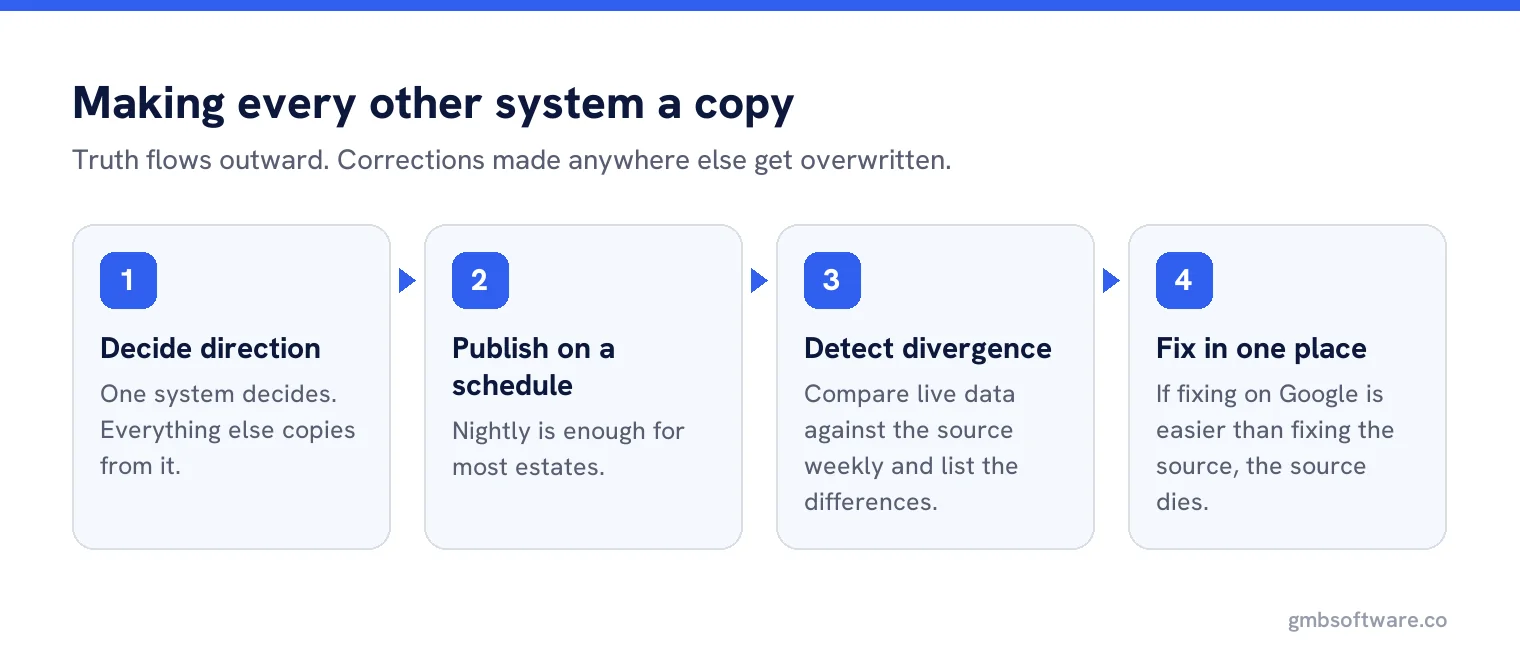
Decide the direction
Truth flows outward, never back. If a change is made directly on Google, it has to be entered in the source as well or it will be overwritten.
Publish on a schedule
Nightly is fine for most estates. Real time is rarely worth the engineering.
Detect divergence
Compare what is live against the source weekly and report differences. Those differences are either bad edits or facts nobody told you.
Make corrections in one place
If fixing something in Google is easier than fixing it in the source, people will do that, and the source dies.
The website is the part people forget
Since Google reads publicly available content including your own site, an out of date location page quietly contradicts your profile. The location page should be generated from the same source, not written once in 2022 by an agency that has since been replaced. This is also why a careful listings programme can be undone by a website redesign nobody mentioned.
Divergence reporting beats perfection
You will never get every system to agree permanently, because the world changes faster than processes do. What is achievable is knowing where the disagreements are. A weekly list of locations where Google and the source differ is more useful than an aspiration to perfect data, and it turns an impossible goal into a short, finite task list.
A worked example
A pharmacy chain with 62 branches had hours in four places: a wall planner in head office, the website, Google, and a spreadsheet the area managers updated when they remembered. Christmas was the annual disaster, with six branches publishing hours they did not keep and two publishing none at all.
The fix was not software. It was deciding that the rota system, which the branch managers already used every week to staff the counter, owned opening hours, and that everything else copied from it nightly. Head office kept the name, category and address. The spreadsheet was deleted, publicly, in a meeting, because a source of truth survives only if its competitors are genuinely retired.
The first divergence report showed 19 branches where Google disagreed with the rota. Eleven were stale on Google, five were rota errors nobody had noticed, and three were genuine local arrangements that had never been written down anywhere. All three of those were the most valuable finding in the exercise.
Where to start if you have nothing
Export what Google currently holds for every location. That export, dated, is your first version of the truth, and it is better than the spreadsheet somebody keeps on a laptop. Correct it with the branches, name an owner per field, then make it the master. Starting from Google’s data has one more advantage: it tells you immediately how far your estate has drifted.
One record, everywhere it needs to go
Hold location data once, publish it to Google and your directories, and see every place the live data has drifted.
Frequently asked questions
What is a source of truth for location data?
The single system where a location’s details are decided. Every other system, including your Business Profile and website, copies from it rather than competing with it.
Does my website affect my Business Profile?
Yes. Google lists publicly available content such as crawled web pages among its sources, so an out of date location page can contradict and undermine your profile.
Which system should hold the truth?
Whichever one the people who know the facts already use. Governance that asks operations staff to log into a marketing tool fails quietly.
Can different fields have different owners?
Yes, and they usually should. Branches own hours and closures, head office owns the name and category. Writing that split down prevents most arguments.
What if I have no system at all?
Export what Google currently holds for every location, correct it with the branches, name an owner per field, and make that export your first master record.
Sources
The Google documentation behind the guidance on this page. Google changes these pages without notice, so check the date on any figure before you rely on it.